Climbing glossary: making sense of climber jargon
Article updated on .
Climbing drags a dense vocabulary along behind it, half technical and half slang, which can make your first sessions in the gym or on the boulders feel like listening to a foreign language. “Drop knee on the volume, crimp the edge, thumb over …”, it all means something, but you need the keys first. This glossary gathers 54 terms of climber jargon, organised by theme, so you can follow a conversation at the foot of a boulder or read a guidebook. It is not exhaustive, but it covers what you hear most often. Each definition stays short, with a few technical details where the detail matters, as with the full crimp or with grades.
Grip types
The grip type is the way the hand makes contact with the hold. It depends on the shape of the hold (jug, edge, sloper, pinch), but also on the climber’s choice: on the same edge you can go full crimp, half crimp, or open hand. Knowing the grip types lets you speak the same language as a climber giving you beta or training advice.
- Jug : a big hold you can wrap your whole hand around, like the handle of a bag. The rest position par excellence on a route.

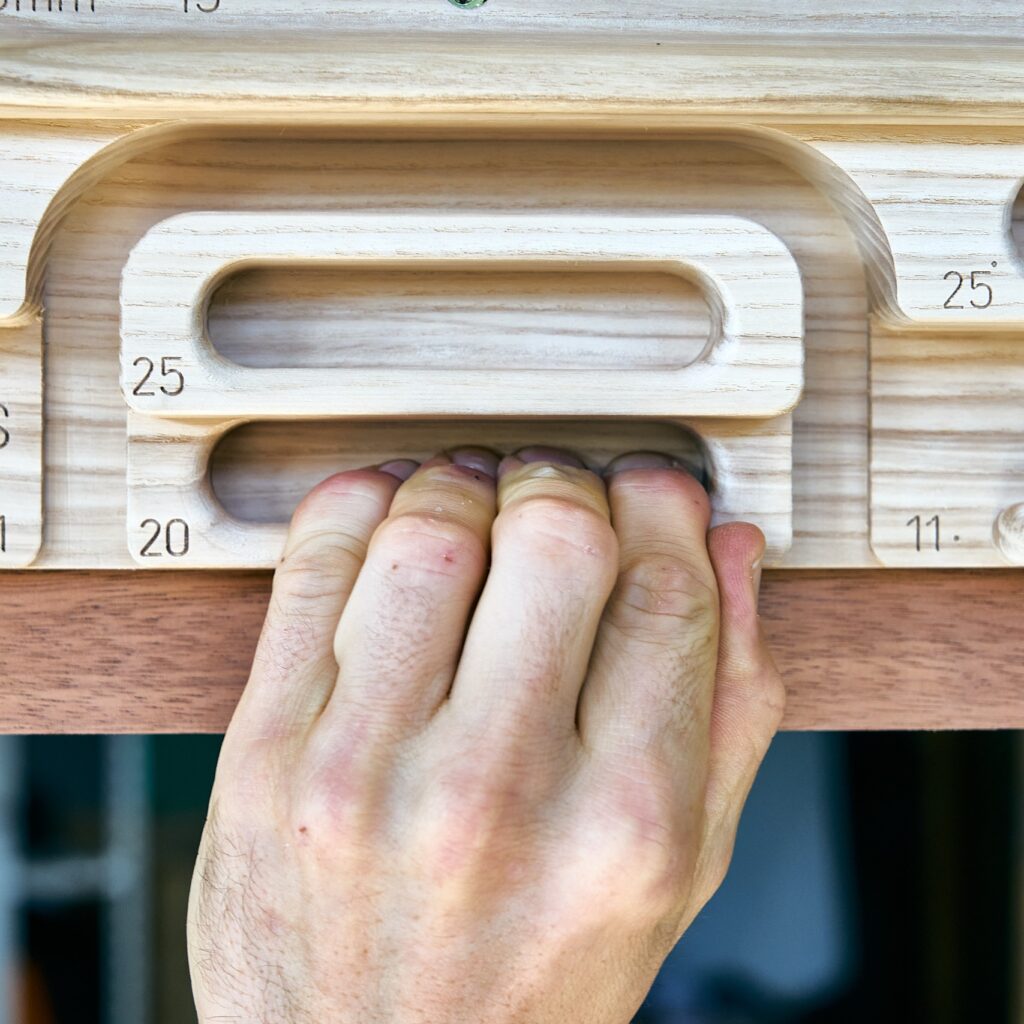
- Edge : a broadly “straight” hold with at least a bit of a lip, 5 to 25 mm deep, taking only 1 or 2 phalanges. The edge is where you train specific finger strength.
- Sloper: a rounded hold with no clear lip, held by friction. Demands precise body position and a lot of skin contact.

- Pinch : a hold you squeeze between the thumb and the other fingers. Works the thumb adductor and whole-hand coordination.

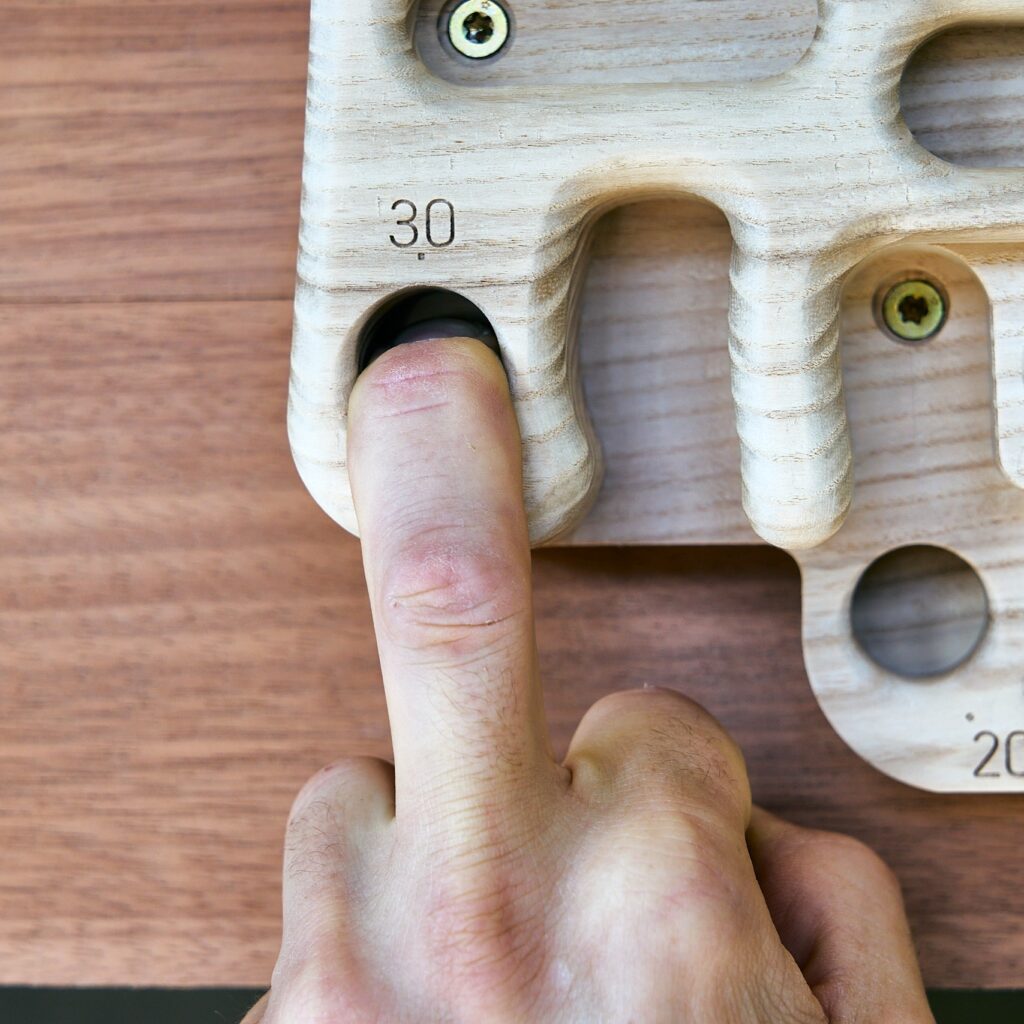
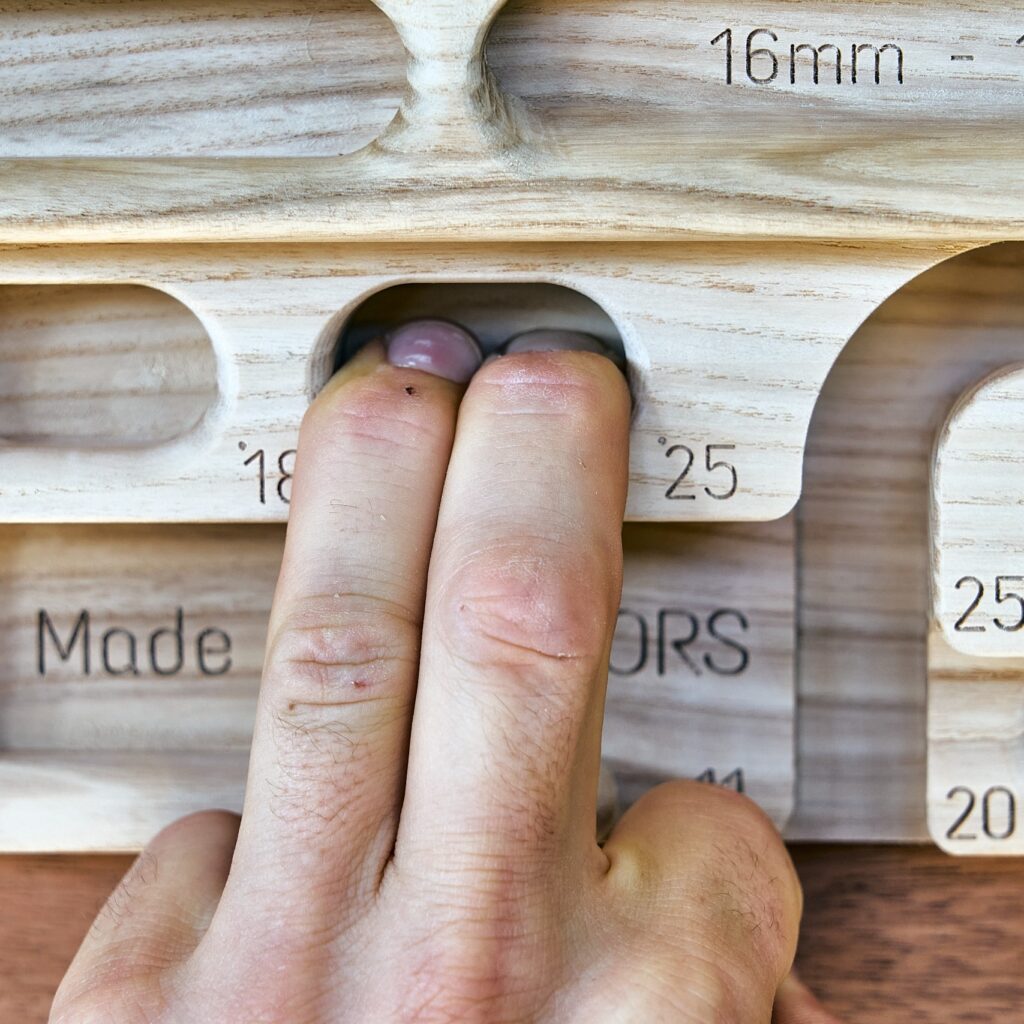
- Two-finger pocket, mono: a hold that only takes 1 or 2 fingers. Harder on the tendons, to be handled with care and after a long warm-up.
- Undercling : a hold taken palm upwards. Demands arm strength and high feet.
- Open hand : a position where the fingers are not flexed, apart from the joint between the first and second phalanges. It is the least traumatic grip for the pulleys.
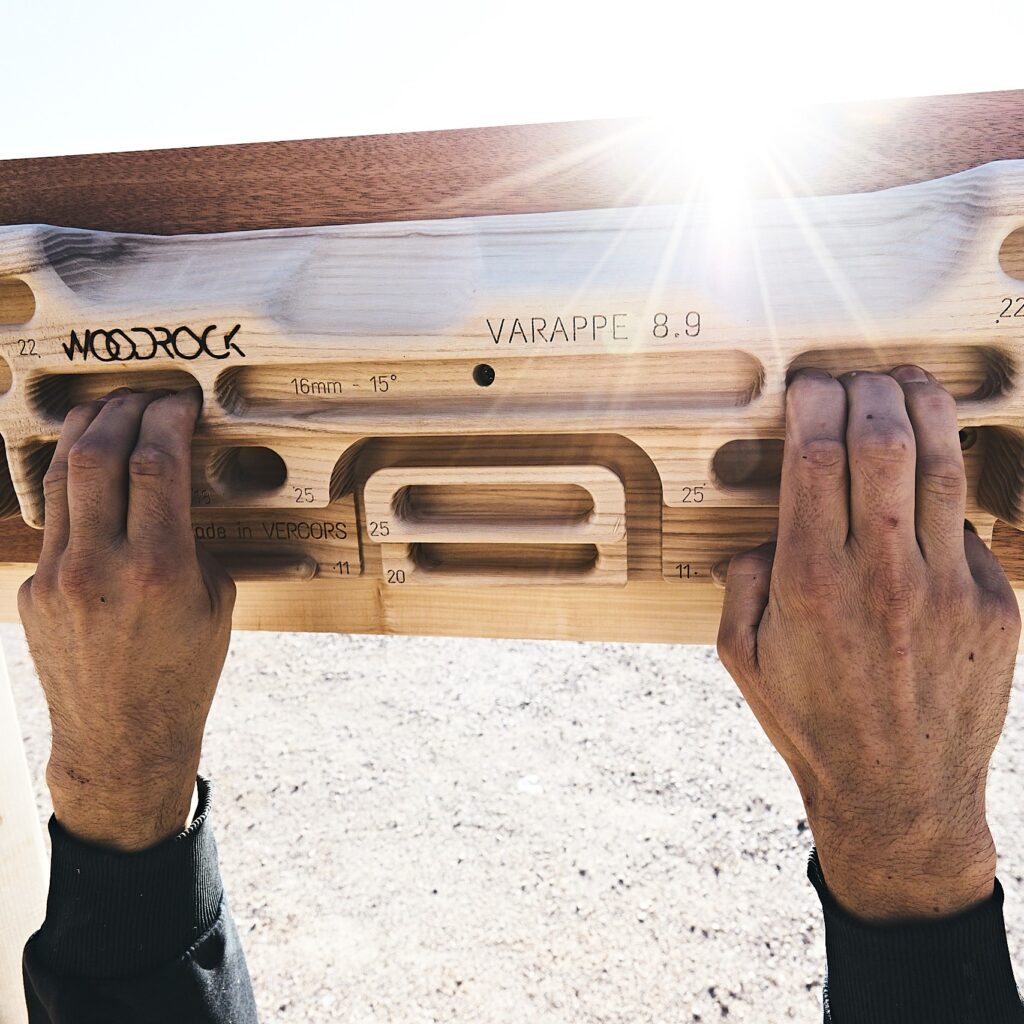
- Half crimp : proximal interphalangeal joint flexed to roughly 90 degrees, distal joint neutral or slightly flexed, thumb free. The reference position for most finger strengthening protocols (max hangs, repeaters).

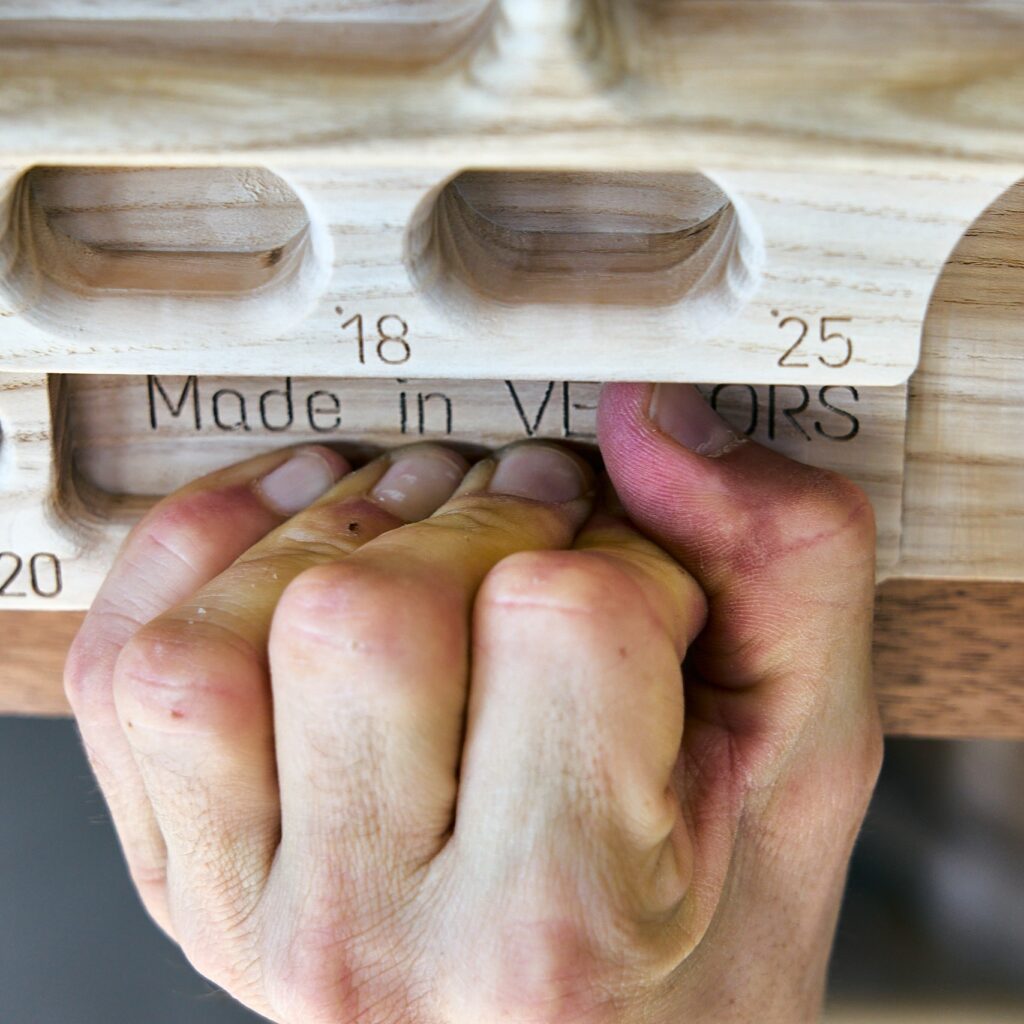
- Full crimp : proximal interphalangeal joint flexed to the maximum, distal joint hyperextended (the fingertip is “crushed” against the hold), thumb locking over the index finger. The most powerful position on a small edge, but also the riskiest for the A2 and A4 pulleys. Use it occasionally, not as training routine.
On preventing the injuries linked to these grips, read also climbing finger injuries.
Movement techniques
Movement in climbing is not just about pulling with the arms. A good part of progress comes from hip and foot placement. Here are the basic techniques that every boulder discussion or route reading uses.
- Heel hook : you hook a hold with the heel rather than the toe. Used to pull with the leg (hamstring and glute), often on overhangs, letting you rise and stay close to the wall while sparing the upper body.
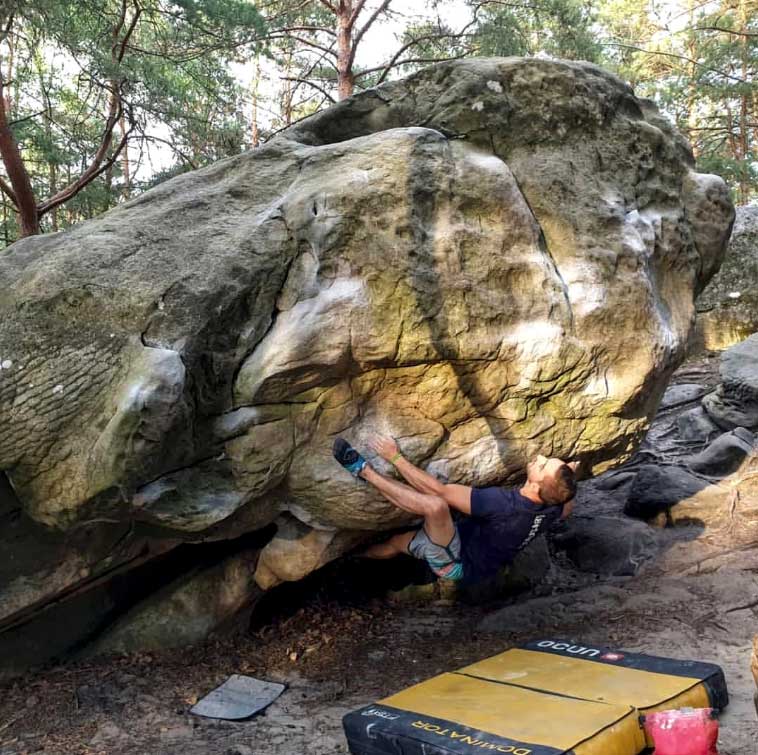
- Toe hook: you hook a hold with the top of the foot (the instep). Essential in modern bouldering and on roofs.

- Drop knee: used mainly on overhangs (sometimes in dihedrals). It means turning one leg so the knee points down or inwards, while still pushing and gripping with the foot. The hips come closer to the wall, which lets you rest or reach a hold with less effort on the arms. The French call it a “lolotte”.
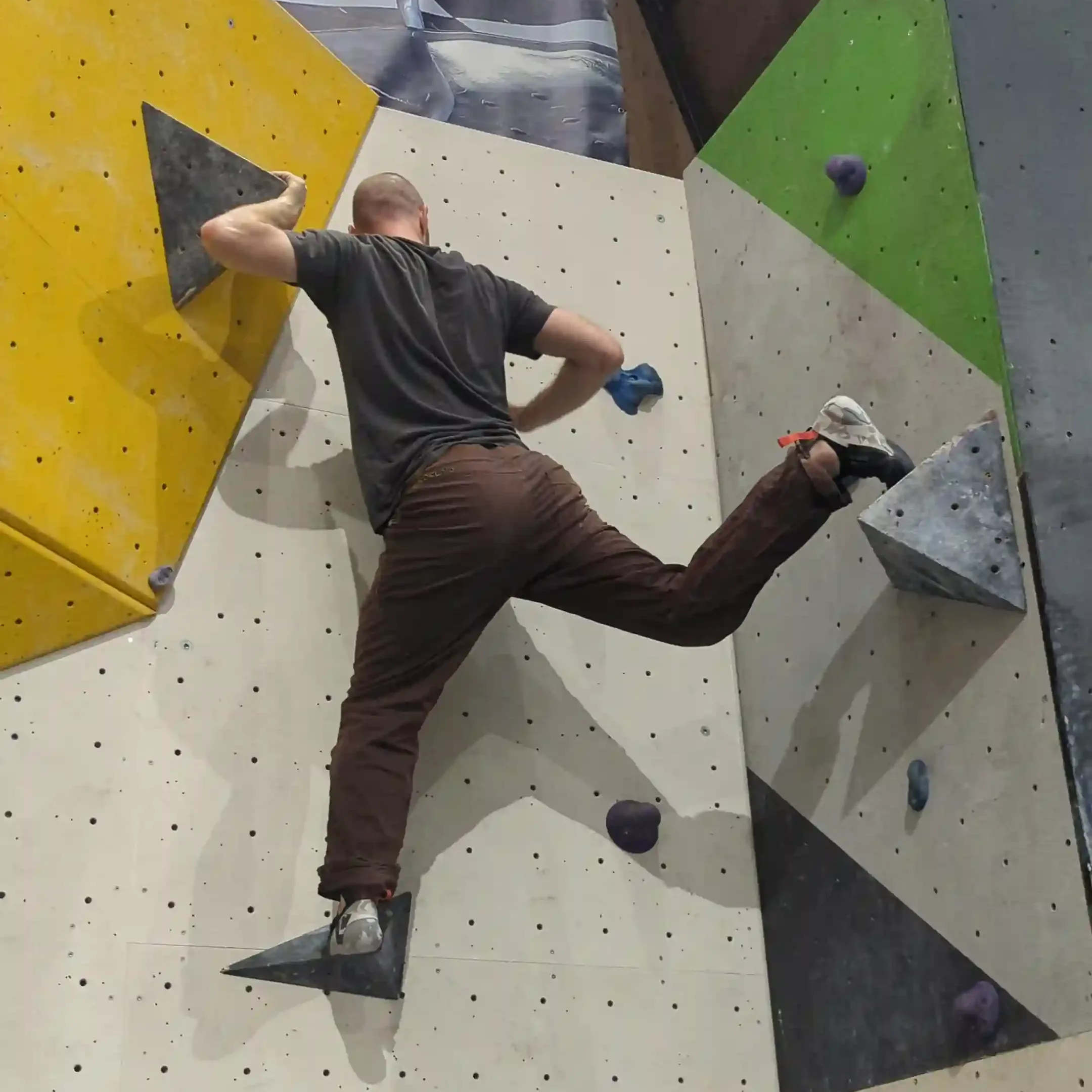
- Compression: a sequence where you squeeze an arête or a volume between both hands (and sometimes both feet). Very demanding on the pecs and biceps.
- Mantel: the move where you switch from pulling to pushing on a hold in order to get on top of it, like getting out of a swimming pool. The signature move of boulder top-outs.
- Dyno: an explosive move where the climber leaves the holds with both hands and feet at once to reach a hold out of static range. Demands coordination and timing.

- No-foot: climbing using the arms only, feet dangling.
- Run-and-jump, wall run: you run along the wall with your feet to build speed and reach a distant hold. Seen in modern bouldering and in competition.
- Smearing: a foot placed on a smooth surface, with no clear hold, held only by the friction of the shoe rubber. Fundamental on slabs.
Equipment
- Crash pad: a thick mat you put on the ground to cushion falls when bouldering outdoors.
- Chalk: magnesium carbonate, which absorbs hand sweat. Liquid chalk comes in a bottle, based on alcohol and carbonate.
- Tape: medical “sticky tape” wrapped around the fingers to support weakened pulleys, or to avoid flappers (holes in the skin).
- Climbing shoes: shoes with a specific rubber sole made for climbing.
- Harness: the webbing worn around the waist and thighs, which holds the climber on the rope.
- Quickdraw : 2 karabiners joined by a sling, which you clip onto a fixed point (bolt) to run the rope through.
- Single rope, half rope: a single rope, used on its own on single-pitch routes. Half ropes, 2 thin strands (often 7.5 to 9 mm) used in parallel, mainly on multi-pitch to manage rope drag and add safety on abseils.
- Hangboard, fingerboard: a wooden or resin board fixed to the wall, with various edges, jugs and pockets. The main tool for specific finger strength training. See how to choose your hangboard.
Levels and grades
The grade indicates how hard a route or a boulder is. Several systems coexist depending on the country and the type of climbing, and the detail of each one is in the climbing grades guide.
- French grade (sport route): an open scale from 3 to 9c. Subdivisions a, b, c with or without + (4a, 4b, 4c, 5a, 5b, 5c, 6a, 6a+, 6b, 6b+, up to 9c). Above 6a, every half grade becomes noticeable.
- Fontainebleau grade: a scale from 1 to 9A, built like the French one but with a capital letter. The world reference for outdoor bouldering. Details and conversion table in bouldering grades.
- V scale : the American bouldering grade system, from V0 to V17. Approximate conversion: V0 ≈ 4, V3 ≈ 6A+, V6 ≈ 7A+, V10 ≈ 7C+, V13 ≈ 8B.
- YDS (Yosemite, routes): the American route grading system, from 5.0 to 5.15d (5.15d = 9c, the highest grade awarded to date).
- Onsight : climbing a route first go, with no prior information other than what you can see from the ground.
- Flash: climbing a route first go, but with information (having watched someone climb it, beta received).
- Redpoint: climbing a route after working and rehearsing it.
- Single pitch: a sport route of one pitch only.
- Multi-pitch: a route of several pitches, with belay stations between each one.
Types of route and terrain
- Slab: a face of rock or wall leaning back (less than 90 degrees). Balance, friction and precision matter more than strength.
- Vertical: 90 degrees, a straight wall. Demands a balance between placement and finger strength.
- Overhang : a wall leaning past 90 degrees. The arms and the core work hard, and hip placement becomes critical. See also how to improve at climbing.
- Roof : a horizontal section, a pure ceiling. Maximum difficulty for the trunk and the arms.
- Bouldering: climbing short, very intense sequences (3 to 12 moves), without a rope, with a crash pad or mats for the landing.
- Trad: climbing on unbolted or barely bolted rock, where the climber places their own protection (nuts, cams).


- Aid climbing: you make progress by pulling on the gear instead of climbing free.
Training and progression vocabulary
- Crux: the hardest section of a route or a boulder.
- Beta: the optimal sequence of moves to climb a section.
- Working a route: repeated attempts at a route to memorise it and link it over several sessions.
- Project: a route or boulder at the limit of your level, worked on over several sessions or even several seasons.
- Setting: designing a route indoors (by a routesetter) or the first ascent on rock (by whoever bolts and cleans the line).
- Plateau: a period of stagnation with no visible progress. Often the sign that a training parameter needs changing (volume, intensity, type of effort).
- Deload: a low-volume recovery week or block after an intense training period, to allow supercompensation.
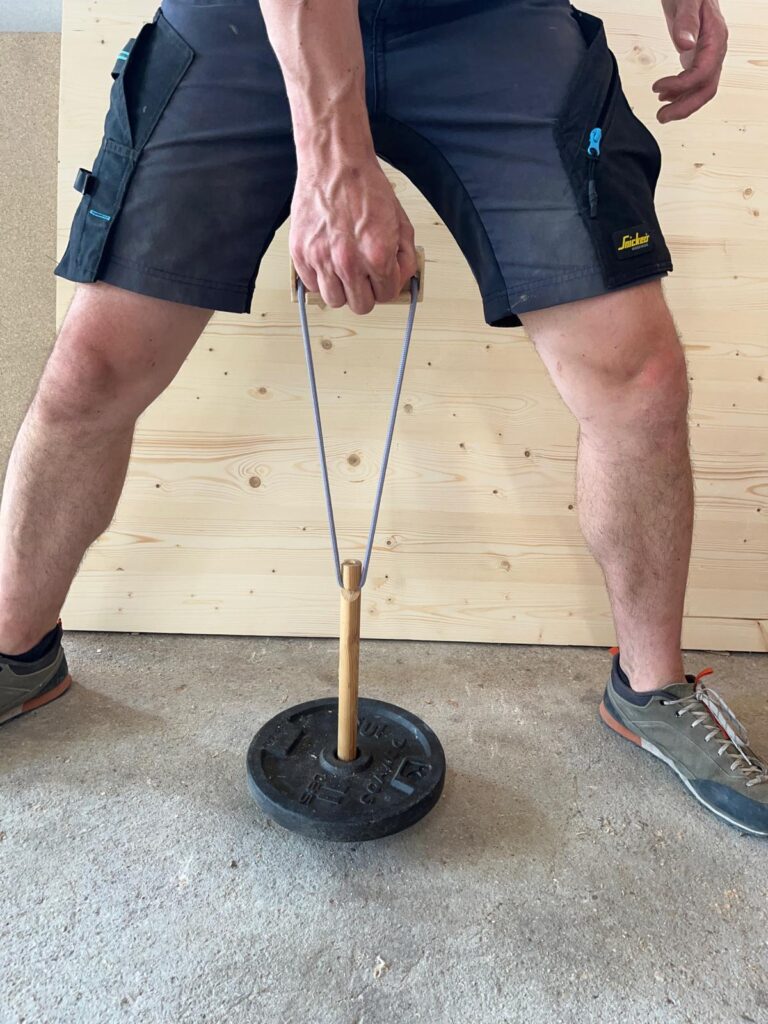
- No-hang: an exercise with no hanging, feet on the ground, pulling on a portable device such as Le Bloc, to dose the load precisely and isolate the finger flexors without loading the shoulders.
Route reading and tactics
- Reading the route: working out the sequence of moves from the ground, identifying the holds, spotting the rests and the crux. A step beginners often skip.
- Rest: a position where the climber can relax one arm (or both), often on a jug, a knee bar …
- Top rope : climbing with the rope already running through the anchor at the top of the route, the belayer taking in the slack as you go.
- Pacing: the ability to dose your effort, to alternate fighting phases and active recovery phases on a long route, and arrive at the crux with something left. A central notion on hard single pitches and on multi-pitch.
To go further on the preparation side, see warming up for climbing and the complete programme of hangboard exercises. On the equipment side, the Origin, the portable hangboard and the Le Bloc version cover the needs of beginners through to advanced climbers.
A propos de l’auteur
Woodrock c’est le mariage de 2 passions : la menuiserie et l’escalade. Concevoir, fabriquer, usiner et vous envoyer des poutres d’escalade de qualité est une partie de mon quotidien. Le reste du temps, j’aime grimper sur les falaises des contreforts du Vercors.