Controversial grades, downgrading: Akira, Bibliographie, DNA. Who decides what counts as 9c?
A climbing grade is not handed down by a committee. No jury, no federation, no measurement protocol. The first ascensionist proposes a grade, and the repeaters will confirm it or adjust it up or down. On a 6a there are plenty of repeaters, and consensus comes quickly. On the hardest grade of an era, a repeat can take years, even decades. The higher the level goes, the fewer climbers there are able to arbitrate. That is the whole paradox at the top of the pyramid: the grade is both more disputed and less disputable, because nobody has the arms to argue.
This article goes back over 3 controversies that shaped the debate at the very top: Akira in 1995, Bibliographie in 2020, DNA in 2022. 3 verdicts that look nothing alike. And a fourth debate, more recent, that changes the nature of the question itself: does a grade rate the rock, or the human experience of it?
1995, Akira and the birth of the scandal
Charente, 1995. Fred Rouhling, a French climber, frees a route in a forgotten cave and proposes a grade that lands like a bomb: 9b. The first 9b in history, at a time when 9a+ does not yet exist institutionally. Nobody has graded anything above 9a at that date. Rouhling’s proposal jumps 2 notches at once.
The international reaction is brutal. People talk of fraud and mythomania. Several things feed the suspicion: the route is partly unprotected, its reputation is murky, and nobody comes to repeat it and check. Akira becomes a legend, cited in the climbing magazines as an example of what not to do: grade too high, too early, too alone.
For 25 years, the route stays a mystery. Too dangerous for some, too suspect for others. The isolation protects the grade as much as it invalidates it: no repeat, no consensus, so no verdict.
2020, the rehabilitation and the downgrade of Akira
Late 2020, Seb Bouin and Lucien Martinez decide to go and see. Bouin, who is collecting 9a+ and 9b at that point, is one of the few climbers able to assess Akira. Verdict after the repeat: the route is hard, but it is 9a, not 9b.
An official downgrade, then. 2 notches below the initial proposal. On paper, it is a retroactive humiliation for Rouhling. In practice, it is a rehabilitation. In 1995, 9a had only just been confirmed (Action Directe, Wolfgang Güllich, 1991). Proposing 9b at that point meant projecting the sport 2 decades forward. The measure was high, the intuition was right: Rouhling had identified a movement and a format of difficulty matching what the community would later call, without him, the modern top level.
The final grade puts the historic performance back where it belongs. Akira is still a 9a freed in 1995, which made it at the time one of the hardest routes in France. The scandal will remain as a textbook case.
2020-2021, Bibliographie and the humility of Alex Megos
Céüse, August 2020. Alex Megos makes the first ascent of Bibliographie, a long-standing project in the legendary Berlin sector. He proposes 9c. At that moment, that makes it the 2nd route at that level in the world, after Silence, freed by Adam Ondra at Flatanger in 2017. He argues his case: years of attempts, a comparison with his other 9b+s.
A year later, August 2021, Stefano Ghisolfi sends Bibliographie in his turn. The Italian finds better beta, optimises his use of kneepads, shortens the crux sequence. His proposal: 9b+. A downgrade of half a notch.
The reaction from Megos is praised by the whole community. He publicly accepts the downgrade, acknowledges that Ghisolfi’s beta is more economical than his own, and confirms that his initial proposal was probably too high. That humility did a lot to rehabilitate the idea that grading is a collective process.
The lesson is clear. The first ascensionist does not decree, he proposes. The community does not validate in one block, it adjusts repeat after repeat. And the final grade, when it finally settles, is always a compromise between the hardest version and the most optimised version of the same sequence.
2022, DNA and the vertigo of a 9c left hanging
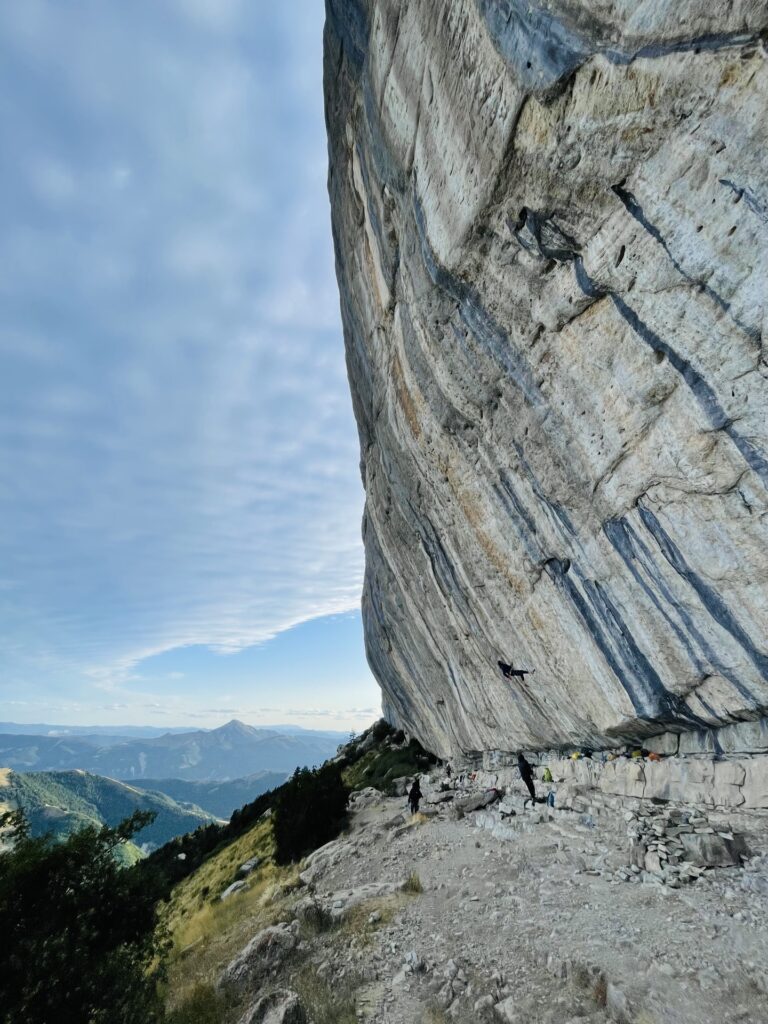
Verdon, 2022. Seb Bouin frees DNA, a project on the Escalès cliff. He proposes 9c and argues his case methodically: time spent compared with his confirmed 9b+s, number of attempts. He does exactly what you expect from an honest ascensionist at the top of the sport.
Bouin does not stop at the proposal. He publicly calls on the community to come and try it, to confirm or disprove. That is the gesture that saves modern grading from the charge of ego: admitting that you do not settle it on your own.
Except nobody comes. Or rather: nobody comes for long enough. The climbers in the world able to assess a 9c number 4 or 5, and they have their own projects and their own crags. The Verdon is far away, and the investment needed is out of all proportion for a verdict that will add nothing to their own record. The grade of DNA stays in limbo, neither disproved nor confirmed, 3 years after the first ascent.
A typical case at the top of the pyramid. When the pool of repeaters shrinks to a handful, the consensus mechanism gets slower. The grade floats, hanging on attempts that may never come. To understand how a grade is built under normal conditions, see how climbing routes are graded.
Ego, sponsors, and the fear of being downgraded
Above 9b+, proposing a grade becomes a political act. The pros know that a downgrade is paid for in credibility and in sponsorship. A route graded 9c that drops back to 9b+ after a repeat is one title less on the record and one line less in contract negotiations.
Some use the slash /: 9b+/c, which amounts to saying: it is between the two, the community can settle it. The device avoids accusations of overgrading and leaves the door open to a later consensus.
A grade is also a symbolic object, loaded with economic stakes. The climber’s technical honesty (which would grade what he actually felt) is in tension with his sporting interest (which would grade what will survive the repeats). The best manage to reconcile the 2. Most arbitrate, consciously or not, in favour of the second.
The 2025 debate: is grading sexist?
June 2025, Kimbrough Moore, a climber and professor of philosophy at the University of San Francisco, publishes an essay that shifts the whole discussion. His thesis: routes have historically been put up by men of around 1.75 m, which creates a structural bias in the grading system itself.
A 6a with a big dynamic move is climbed statically by a first ascensionist of 1.75 m, and as a committing dyno by a climber, woman or man, of 1.60 m. The physical effort and the psychological commitment are not comparable. Yet the route carries a single grade, calibrated on the dominant build. For smaller bodies, the same 6a can mean a real effort equivalent to 6b+, or even 6c.
Moore proposes generalising multiple grades systematically. No more single grade, but ranges (7a/6c+) reflecting the difficulty as it is felt by different builds. It would be a deep overhaul of the system, turning grading from an “objective” reference point into a contextual one. The subject goes beyond the question of gender, it touches every minority morphology, very tall climbers included.
The reply: Bill Ramsey against systematic slash grades
Bill Ramsey, 64, a philosopher-climber based in Nevada, publishes a reply shortly afterwards titled “Rethinking Slash Grades”. His argument takes the opposite line to Moore while acknowledging that the morpho bias is real.
For Ramsey, systematically multiplying grades according to morphology would create 3 problems. First, an illusion of differentiated difficulty, which would suggest that a route is intrinsically harder for certain bodies, when it is simply different. Then a fragmentation of the shared reference: if every climber has their own personal grade, comparing 2 ascents becomes impossible. Finally, an implicit infantilising of small climbers, who would be told, here is your own grade, instead of being left to judge the gap with the official grade themselves.
His position: a route has a grade, and everyone is free to assess it against their own body. The current system has its flaws, but it preserves the universality of a shared reference point. The slash grades that already exist (8a/8a+ and the like) must stay the exception, kept for routes whose difficulty is genuinely ambiguous from the first ascensionist’s point of view, not a systematic tool for morphological differentiation.
The debate has been raging across the Atlantic since the summer of 2025, and is starting to make its way back to Europe. The specialist magazines are picking it up, podcasts devote hours to it. The federations are watching the discussion warily. Everyone senses that this is about more than a quarrel between scholars.
And where does France stand in all this?
The French tradition stays relatively homogeneous. Few systematic slash grades, few public quarrels about downgrades, a tacit consensus around the idea that grading is imperfect but useful. French climbers accept that a 7a varies by 10% depending on the crag, the rock, the first ascensionist, the humidity, the mood. It is a shared reference point, not an absolute measurement.
The morphology discussion is emerging all the same, above all among the younger generations and among experienced women climbers. More and more, on the forums and in the gyms, you hear the idea that a move is “morpho” and that the grade does not reflect the real difficulty for this or that build. The FFME has not yet taken a public position, but the subject will end up reaching the technical committees. To find your way around the vocabulary, our climbing glossary covers the essentials.
For comparison, the basic principles of grading apply whether you are on plastic or on rock: route grading and bouldering grades follow distinct logics but both rest on the same consensus mechanism.
3 cases, one and the same consensus mechanism

Grading is a consensus in motion. The first ascensionist proposes, the community arbitrates, and the final grade only appears after several repeats. Akira took 25 years to find its verdict, Bibliographie 1 year, DNA is still floating after 3 years. The higher the level goes, the more the mechanism seizes up, because the pool of repeaters shrinks until there are not enough of them.
The morpho debate of 2025 is probably the most important philosophical turning point since slash grades were invented. It no longer asks only how we grade, but what we grade: the piece of rock or the human experience. Whatever the outcome, French grading will probably go on favouring the single grade, but with a clearer awareness of what it leaves out.
For anyone who climbs, the practical consequence is simple. A downgrade repositions a performance within the shifting reference frame of the community. When you come across a disputed grade, go and look at the repeaters and their reports before making up your mind.
A propos de l’auteur
Woodrock c’est le mariage de 2 passions : la menuiserie et l’escalade. Concevoir, fabriquer, usiner et vous envoyer des poutres d’escalade de qualité est une partie de mon quotidien. Le reste du temps, j’aime grimper sur les falaises des contreforts du Vercors.