Training finger strength for climbing
Article updated on .
Finger strength is the limiting factor in climbing: with equal technique, it is what decides between holding the crux hold and dropping it.
What you are really training when you hang
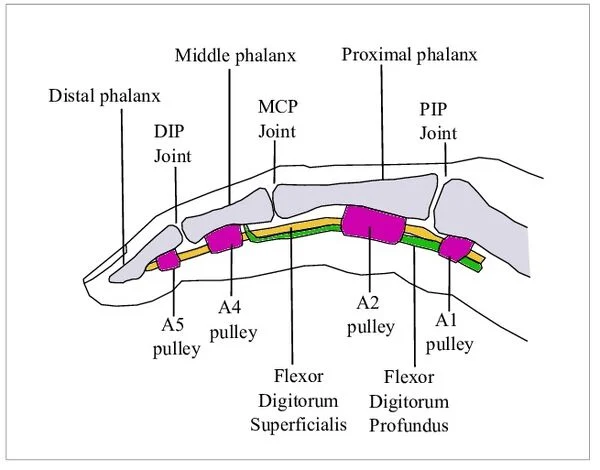
The “finger muscles” are actually in your forearms: the superficial and deep flexors. When you hang, those muscles pull on tendons that slide through a series of fibrous rings, the pulleys. The best known are A2 (at the base of the finger) and A4 (on the middle phalanx). When climbers talk about a pulley rupture, it is almost always A2 on the middle or ring finger.
3 main grip positions in climbing:
- Open hand: fingers almost straight, thumb relaxed. The least aggressive position for the pulleys. Favour it for volume.
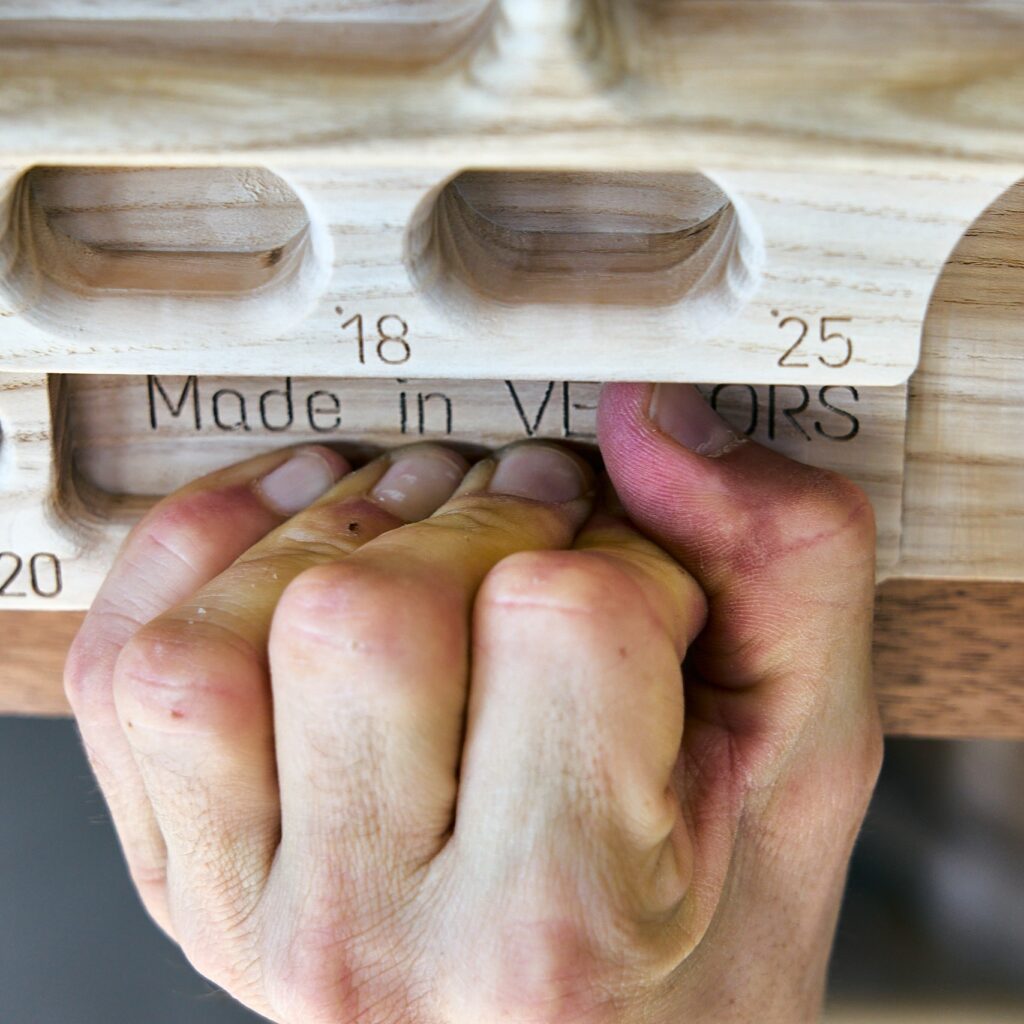
- Half crimp: first joint at 90°, the others relaxed. The best strength/safety compromise. It is the position that Mobråten and Christophersen identify in The Climbing Bible as the most useful on small holds.

- Full crimp: proximal interphalangeal joint flexed to the maximum, distal interphalangeal joint in hyperextension (fingertip “crushed” upwards), thumb locking over the index finger. That bony lock applies extreme force to the A2 pulley, it is the most powerful position but the one that breaks pulleys.

A smart training programme therefore favours the half crimp and keeps the open hand for volume. The full crimp only comes out for short, carefully dosed touches.
The 4 methods that work
Golden rule, to carve in before going any further: none of the protocols below is done cold. Count on 20 to 30 minutes of warm-up before the first working set: joint mobilisation, hangs on big holds, light hangs adding load progressively … Skipping that step is exactly the script for an A2 pulley rupture.
1. Max hangs: the reference for maximum strength
Short hangs, heavy load, plenty of rest. Find a load (added or deloaded) that lets you hold exactly 7 seconds, with 2 to 3 seconds of margin before your form breaks.
- 5 minutes of rest between each hang, 5 hangs
- If you hold more than 10 seconds: add weight. If you do not reach 7: lighten up.
It is the exercise that creates the biggest neural adaptation in 6 to 8 weeks. But also the most demanding on the pulleys: 2 sessions a week maximum, never back to back.
2. Repeaters: for power endurance and the base
Repeated hangs with micro-recovery. The reference protocol:
- Classic repeaters: 7 seconds of hang, 3 seconds of rest, the whole thing repeated 7 times. That is one set. You link 4 to 5 sets on 4 to 5 different grip positions, with 2 to 3 minutes between sets.
- Long repeaters: 10 s on / 5 s off × 4, 3 to 5 minutes between sets (for advanced climbers).
The last hang of every set must be close to failure. If you finish fresh, add weight. If you drop before the 7th rep, lighten up. It is the exercise to favour for the intermediate climber who wants a solid base before max hangs.
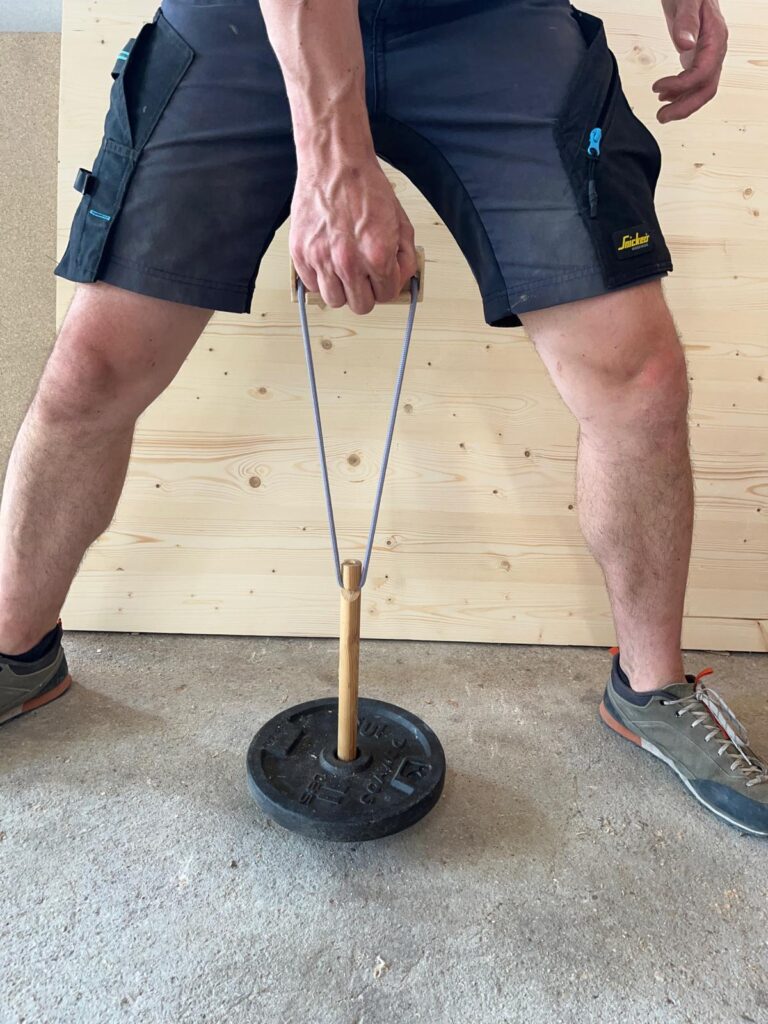
3. No-hangs: training your fingers with your feet on the ground
Rather than a hang, which also loads the elbows and shoulders heavily, you pull upwards on a grip that is loaded or anchored to the ground. You control the load down to the finest detail and you can work very close to your limit without structural risk.
- Find a load that lets you do ~8 reps close to failure
- 3 sets per hand, 3 minutes of rest between sets, 1 rep in reserve on every set
Very useful to alternate into maximum strength work to reduce shoulder joint fatigue.
An 8 week programme
For an intermediate climber (solid 7a to 7b, 3 years of climbing), here is the framework I recommend:
Before you start, run a benchmark. Find your maximum load for 7 seconds in a half crimp on a 20 mm edge, and write it down. That number is the reference for calibrating the weights of the cycle and measuring the gain at the end of the 8 weeks. Without a baseline, the programme is blind.
Hangboard load calculator
From your max hang and target intensity, we compute how much to load or unload for the session.
Weight to add Unload required Bodyweight only, no adjustment
— kg
Target load: kg
Pulley counterweight: kg counterweight (single pulley).
Resistance band: equivalent tension ~ N
| Week | Session 1 | Session 2 |
|---|---|---|
| 1 to 3 (base) | aerobic work | aerobic work |
| 4 to 5 (transition) | Max hang -10 to 15% + aerobic | Max hang -10 to 15% + aerobic |
| 5 to 6 (max strength) | Max hang 5×7 s, half crimp | Max hang 5×7 s, open hand |
| 7 (intensity) | Max hang 5×7 s half crimp | Aerobic |
| 8 (taper) | Max hang 3×7 s half crimp -10% load | Aerobic |

After week 8: 7 to 10 days of near complete rest (easy climbing for fun, no hangboard), then a max strength test on a benchmark hold. The typical gain over this cycle: 5 to 10% more load held for the same duration. If you are not progressing, the programme is not the first thing to change: it is your sleep and your food.
Why the hangboard isolates what a route never measures
On a route or a boulder, the load on your fingers depends on a thousand variables: your body position, the quality of the hold under your feet. You cannot dose it precisely. On a hangboard, you know exactly the depth of the edge, the same one every session. You measure the added or deloaded weight to the kilo, you time it, you compare with the previous session. Isolation is the condition for measurable progress.
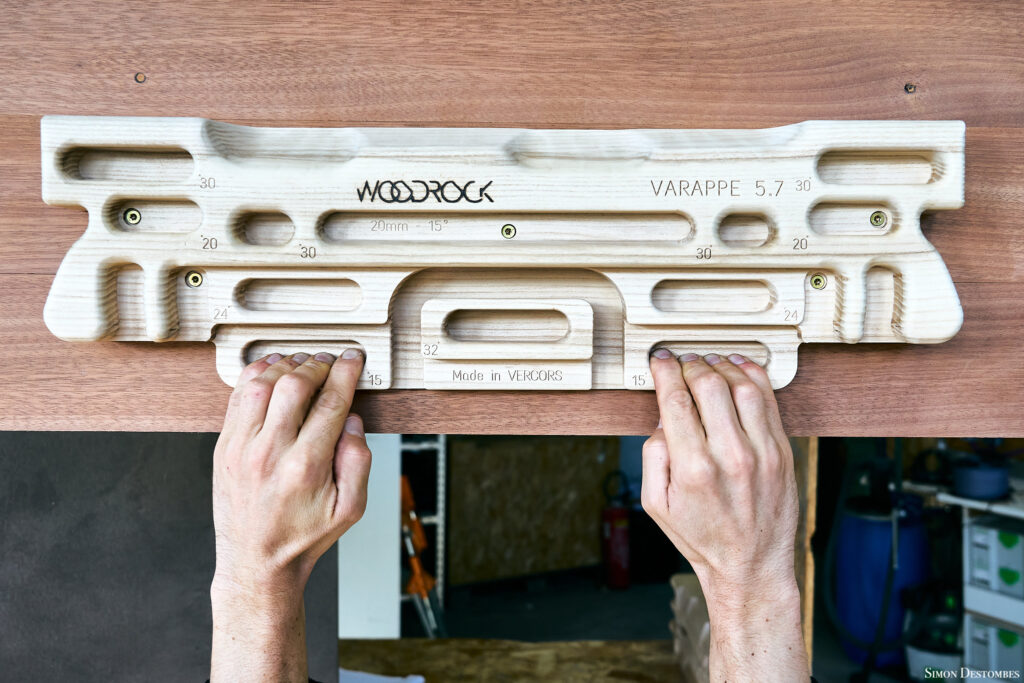
That constraint is what shaped the Woodrock range: constant depths, the same reference points from one session to the next. Le Bloc covers every protocol. The Varappe 8-9 goes down to 10 mm, which stays useless or even counterproductive as long as you are not comfortable on 20 mm. The Varappe 5-7 targets intermediate to advanced climbers. Origin varies the demands the most on a single tool.
3 mistakes that cost you a season
- Rushing onto small edges. A 10 mm edge means around 50 kilos applied to 2 cm² of tendon. As long as you cannot comfortably hold 20 mm in a half crimp with added weight, you have no business on 10 mm.
- Neglecting the extensors. Climbers build the flexion of the fingers enormously and the extension very little. Climbing generates 2 elbow tendinopathies. Medial epicondylitis (Golfer’s elbow, inner side of the elbow) comes from the flexors and from pulling: it is the classic “climber’s pain”. Lateral epicondylitis (Tennis elbow, outer side) comes from the wrist extensors that stabilise the hand when the flexors pull. Prevention with an extensor band or PowerFingers mainly targets the latter, but flexor/extensor balance reduces the risk of both. A PowerFingers or an extensor band, 3 sets of 15 reps, 2 times a week, and you rebalance. 5 minutes. That is all.

- Ignoring the warning signs. Pain at the base of the finger that lasts more than 24 hours, an audible pop during an effort: those are pulley signals, not muscle soreness. Stiffness that lingers when you wake up, same thing. Stop. How to recognise and manage finger injuries.
Frequently asked questions
What level do you need before you start hangboarding?
The myth of 3 years of climbing before the hangboard is dead. From 6 to 12 months of regular practice, you can train, as long as you keep your feet on the ground. No-hangs and deloaded hangs are in reality more controlled than bouldering or route climbing at your max or supra-maximal level. What changes with experience is the load you can take and the autonomy to choose your protocols.
Should you do max hangs or repeaters?
Both are possible, but not at the same time. A 6 to 8 week cycle oriented towards max strength (max hangs dominant), then a 6 to 8 week cycle oriented towards power endurance (repeaters dominant). Alternating the blocks makes you progress on both qualities.
How long does it take to gain max strength?
4 to 6 weeks for the first neural adaptations (you pull harder without weighing more). 3 to 6 months for lasting structural adaptations in the tendons and pulleys.
Should you train while injured?
On a real pulley injury: rest, then very progressive loading, ideally supervised by a physiotherapist trained in climbing. No-hangs are precious then: you can start the rehab with very little added weight.
A propos de l’auteur
Woodrock c’est le mariage de 2 passions : la menuiserie et l’escalade. Concevoir, fabriquer, usiner et vous envoyer des poutres d’escalade de qualité est une partie de mon quotidien. Le reste du temps, j’aime grimper sur les falaises des contreforts du Vercors.