
Gym vs rock grades: why you fall off 6a outdoors
You’re 1m65, you send 7a in the gym twice a week, and the first time you set foot on a 6a at Buoux, you fall off on the third move. You get back on, you fall off again. You feel like you’ve been had. You go looking for the miracle hold that doesn’t exist, you look down at your belayer, you lower off wondering whether you’ve gone backwards.
That gap between gym grades and crag grades, everyone lives it. It isn’t an ego problem. It’s a structural gap, and it rests on 4 factors: the history of the first ascents, the economics of commercial gyms, the nature of the rock itself, and commitment.
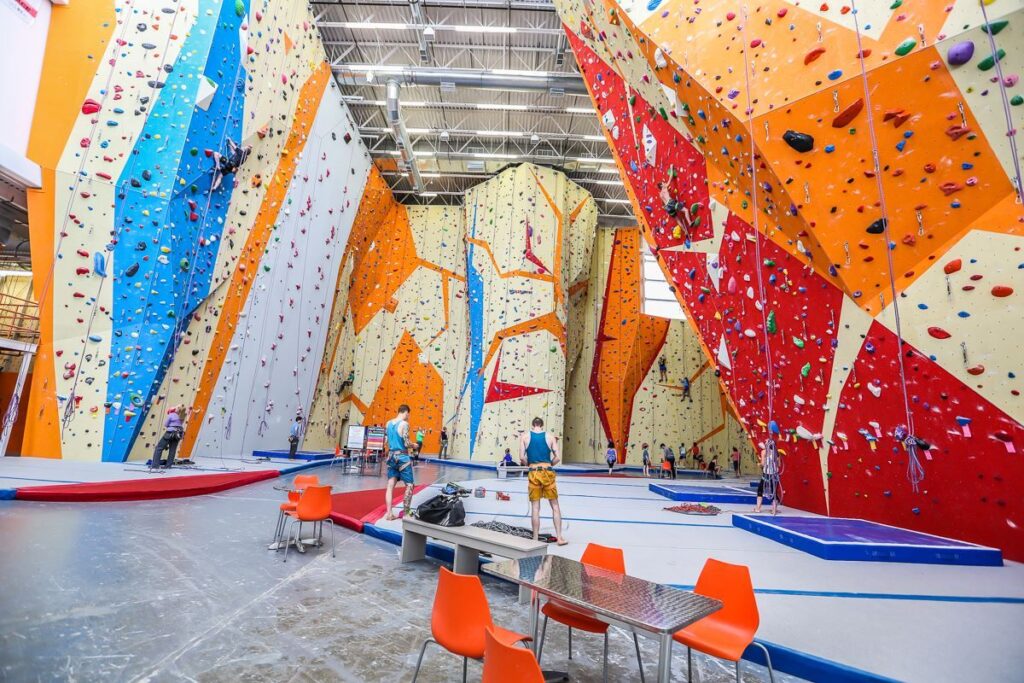
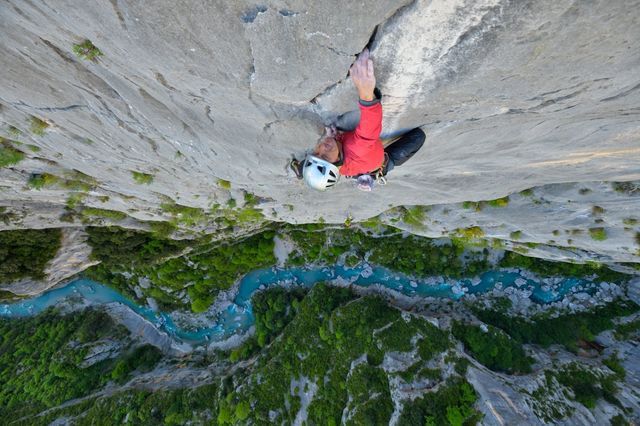
When the 6a is 50 years old
The historic routes at Buoux, the Verdon and the Saussois were put up between 1975 and 1990 by climbers who were rewriting world standards every summer. Patrick Edlinger, Jean-Baptiste Tribout, Antoine Le Menestrel and Marc Le Menestrel graded their first ascents against their own yardstick, the one of an era when 8a had only just been born and 7c was still a world frontier.
In practice, a 6a put up at Buoux in 1985 could be a 6b at another crag. Same on the Verdon multi-pitches from the 1980s. Standards have drifted everywhere over the last 40 years. The result is a gap of 1 to 2 notches between a Buoux 1985 6a and a Climb Up 2025 6a.
To get the general logic of the grading system:the article on climbing grades, then route grades.
Indoor inflation: why gyms grade soft
A commercial climbing gym is a business. It lives off memberships and the entries climbers pay for. So the climbers have to come back! And to make that happen, gyms can grade “easy” to flatter the ego and keep climbers coming back.
The gyms’ salaried route setters know it. A route graded 6a in the gym pulls in 5 times more people than a route graded 5c. Nobody goes to the gym regularly in order to fail. The business model mechanically pushes the grade upwards, in the middle range (5c to 7a) where the bulk of the members are. At the extremes it tightens up: beginner routes (3 to 5a) stay honest because that crowd doesn’t rely on the grade to judge its level, and hard routes (7c and up) often get recalibrated on strong climbers who demand precision.

Chain by chain, in France
No chain is better than another, each one calibrates for its local clientele and its commercial strategy. Here’s what gets said about the grades at the different chains.

Climb Up
Grades often soft, especially on the bouldering. Classic French scale on the routes, but an in-house conversion specific to each gym in the network. Reckon on about +1 notch compared with a modern sport crag. A Climb Up 6c can be worth a 6b on rock. The network is wide, and the calibration varies between a Paris gym and one out in the regions.
Block’Out
Colour grading on the boulders, no numbers. Fairly true to Fontainebleau bouldering at the upper levels (black, white), soft at the first levels (yellow, green). An average Block’Out black is often an honest Bleau 6B/6C.
Arkose
Uses ranges rather than strict grades, along the lines of “5a-5b” or “6b-6c”. Less flattering, but far more useful for working out your real level. The range forces you to take on several routes in the same sector to calibrate yourself, which is closer to how a crag works.
Vertical Art
Grades at the low end of the European average. The setters there take in more competition climbers, which tightens the standards.
Independent gyms and club walls
They can be closer to crag grading, when the setters are active crag climbers… But that’s not always the case!!
Colour grading: what nobody tells you
The gym colour system (yellow beginner, green easy, blue intermediate, red experienced, black expert, white elite) isn’t a universal grade. It’s an in-house ranking, calibrated by each gym, on its own clientele.
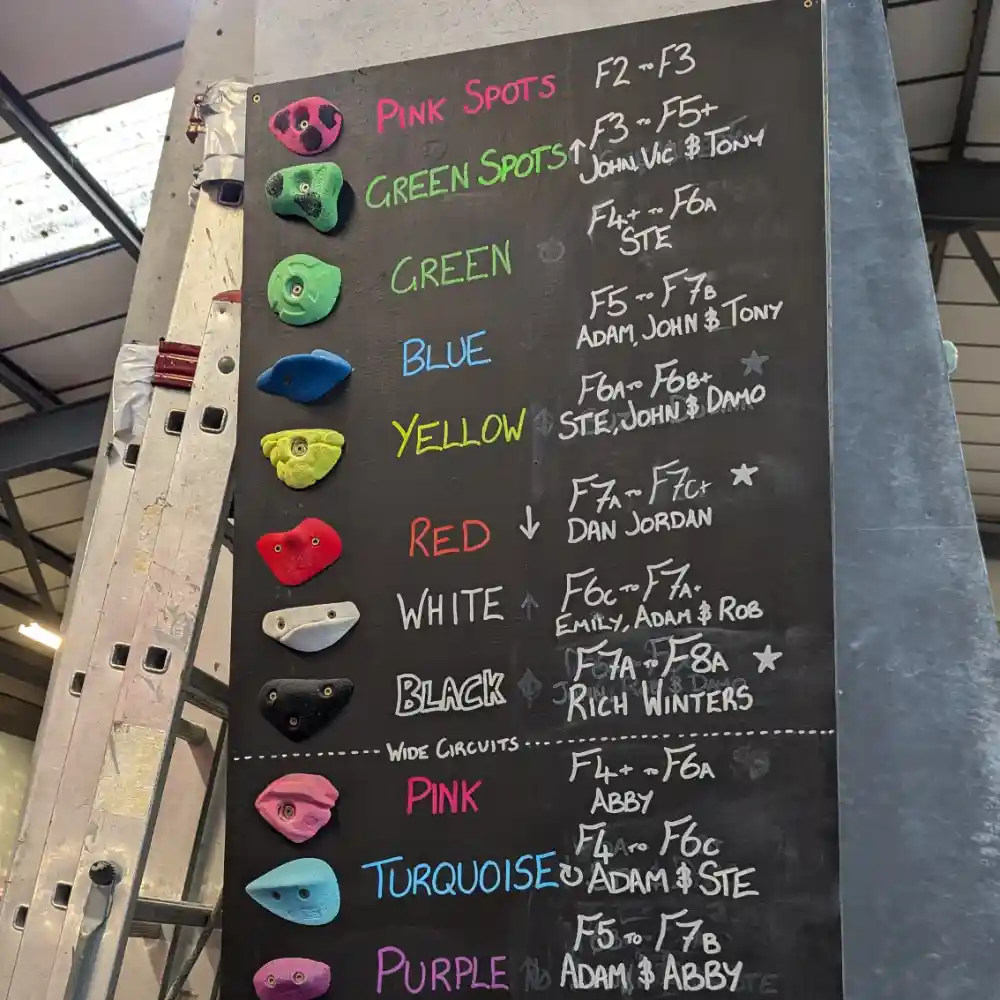
The trap is saying “I get up the blues, so I climb blue” whatever the chain. The best thing is to ask at reception, or ask a setter, for the equivalent range in French grades. Most gyms have a conversion chart on the wall or available on request. Write down the range, not the colour. And compare it with what you actually manage to send onsight, not with what you’re projecting over 5 sessions.
The 5 reasons the crag can feel harder
1. Reading the rock
In the gym the holds are coloured, spottable from 10 metres away, and the sequence is easier to work out from the ground. On rock, part of your effort goes into hunting for where to put your hands and feet. A crag 6a you read badly becomes a 6b in the flesh.


2. Real friction
Rock can have less grain than resin. So the grip can be a lot worse, especially in warm weather.
3. Tiny footholds
On rock, footholds are harder to find, less standardised … So you often have to be more precise: feel the hold under the shoe, adjust the pressure.
4. Commitment
Bolts on a crag are usually further apart than in the gym. 2 to 4 metres on modern sport, sometimes more on historic routes or multi-pitch. In the gym you clip every 1 to 1.5 m.
5. Real grip positions
Outdoors the holds are less often ergonomic. The variety of grip positions on rock is far greater than in the gym, so it asks for more adaptation.
How do you convert your gym level into a crag level?
No rule would be right, because grades between gyms and grades between crags already aren’t consistent. Still, for people who don’t get outdoors much, it seems reasonable to drop the grade you’re aiming for by 1 or 2 grades (if it’s a historic crag).
For a gym climber who onsights 6c indoors, it’s reasonable to start on a 6a at Buoux.
That gap will shrink with the volume of days outdoors. A climber who gets on rock 30 days a year ends up climbing the same level outside as in the gym, sometimes better. A climber who gets out 3 times a year will always keep a significant gap, whatever the gym level. The article on climbing progression goes into the training volumes that help.
Gym bouldering vs bouldering on rock (Bleau, Hueco)
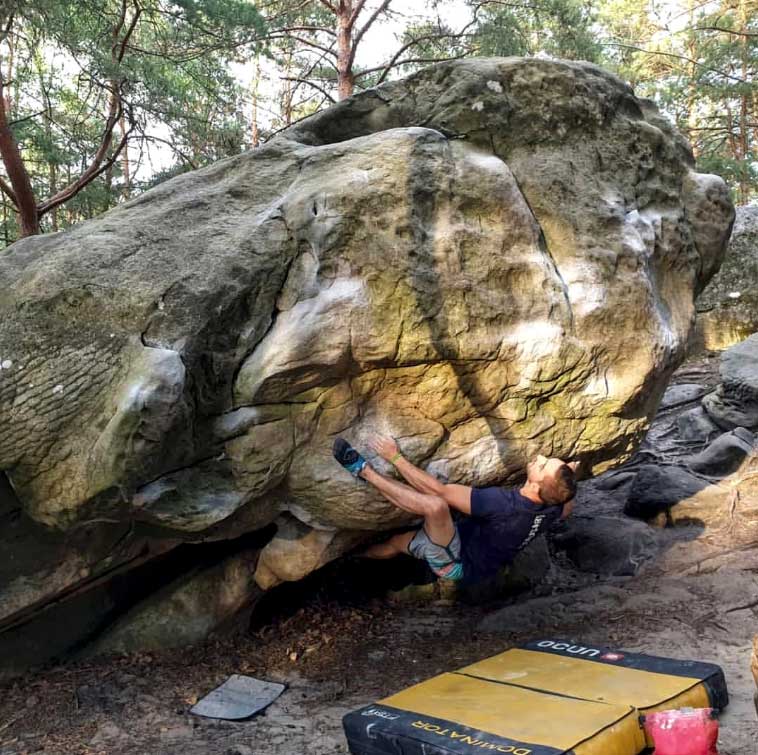
Bouldering widens the gap even further. Fontainebleau has its own tradition, calibrated by generations of first ascensionists in the sandstone over the course of a century. A Bleau 5+/6A can be humiliating for a 6A gym climber: the grain of the sandstone bites differently, and the foot positions are sometimes invisible to an untrained eye.

What to train to close the gap
4 concrete jobs, in order of priority:
- Specific finger strength: The finger strength article gives the protocols. And the hangboard programme lays out the progressions.
- Get closer to specific work: climb routes or boulders inspired by the outdoors, climb on wooden holds, on holds with no grain … basically: vary your climbing as much as you can.
- Work on specific endurance: a crag pitch is more like 25 metres than the usual 12m of the gym. So it can be worth linking 2 routes back to back at the gym to get ready for a different kind of effort.
- Route reading on rock: on every day at the crag, work on the reading: watch the other people climbing (ideally the ones used to climbing outdoors, at a level not too far off your own), do specific “reading” laps … Start with “quality volume”, meaning climbing below your level but staying very focused on movement and reading, before getting on routes at your max.
FAQ
What’s the conversion between Climb Up and the crag?
To be comfortable it can be worth reckoning on -1 to -2 grades for your first days out. The conversion gets sharper with the volume of days outdoors. The more you get out, the more the gap closes.
Why am I useless on rock when I climb well in the gym?
4 reasons stacked up: untrained rock reading, real friction lower than resin, footholds that demand touch, and the stress of the runouts between bolts. You’re not useless, you’re climbing a slightly different sport. Reckon on 10 to 20 days out before the gap starts to close.
A propos de l’auteur
Woodrock c’est le mariage de 2 passions : la menuiserie et l’escalade. Concevoir, fabriquer, usiner et vous envoyer des poutres d’escalade de qualité est une partie de mon quotidien. Le reste du temps, j’aime grimper sur les falaises des contreforts du Vercors.


