Bouldering Grades: Fontainebleau, V-Scale and Conversions
Article updated on .
Bouldering has its own world of grades and its own school rivalries. Fontainebleau and the V-scale coexist everywhere without ever lining up perfectly.
The Fontainebleau grading scale: the historical benchmark
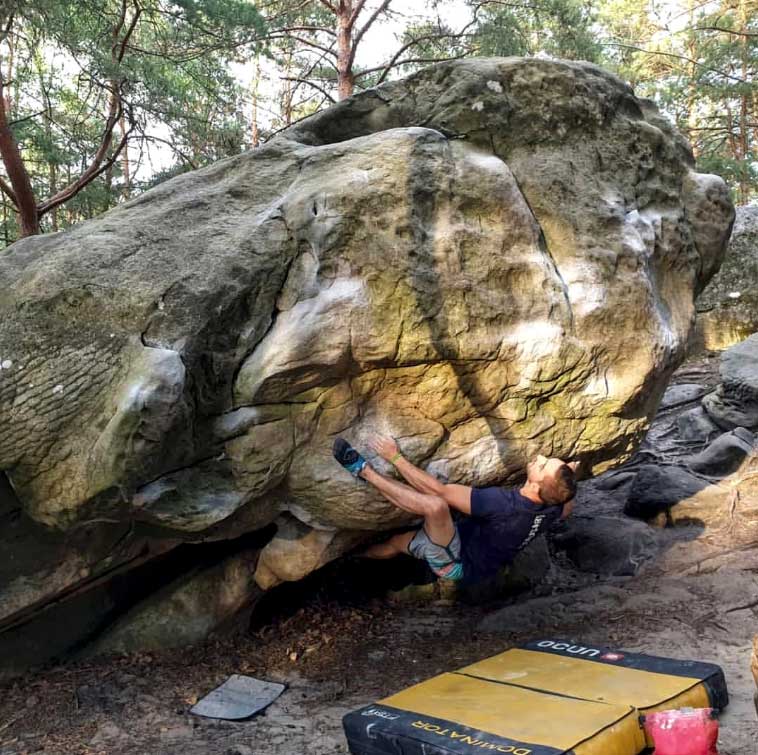
The Fontainebleau scale was born in the sandstone boulder fields of the forest of the same name, south of Paris. From the 1940s and 1950s, Pierre Allain and his contemporaries put up the first problems graded in Roman numerals, then Arabic ones. Michel Libert then formalised a finer scale by adding letters and signs. From the 1980s onwards, Jacky Godoffe put up the benchmark first ascents of modern bouldering at Bleau: C’était demain, 8A in 1984, the first French 8A, is still a historical landmark.
The scale today runs from 3A to 9A. Each number is followed by a letter A, B or C, then optionally a “+”. The full sequence looks like this: 6A, 6A+, 6B, 6B+, 6C, 6C+, 7A, 7A+, 7B, 7B+, 7C, 7C+, 8A, 8A+, 8B, 8B+, 8C, 8C+, 9A. No “-“, and no direct equivalence with the French route scale despite the similar notation.
Font grading separates historical problems from modern problems. A 7A from the 1980s, put up on a slab or an arete at Bleau, is not the same 7A as a modern overhang or a powerful problem set recently. The Font scale factors in reading and Bleau footwork, both very much sandstone-specific. From one area to the next, the comparison stays slippery.
A few global landmarks in Font grades:
- Atomic Playboy, 8A+, Buthiers Piscine: put up by Christophe Laumone. Its shortened version, graded 7C+, is often quoted under the same name.
- Karma, 8A+, Franchard Cuisinière: put up by Fred Nicole in 1995. In June 2001, a vandal knocked a hold off with a hammer: since then, Karma has been graded 8A+ rather than 8A. The boulder you try today is no longer the one Nicole put up.
- Burden of Dreams, 9A, Lappnor (Finland): put up by Nalle Hukkataival in 2016, the first 9A in bouldering history.
- Alphane, 9A, Chironico (Switzerland): freed by Shawn Raboutou in 2022, one of the few confirmed 9As.
The V-scale: the American system
On the other side of the Atlantic, John “Vermin” Sherman invented his own scale at Hueco Tanks, Texas, from 1991 onwards. The “V” in V-scale comes straight from his nickname. Sherman proposed a linear, simple scale: a single number, no letter. It starts at V0 and has no theoretical ceiling.
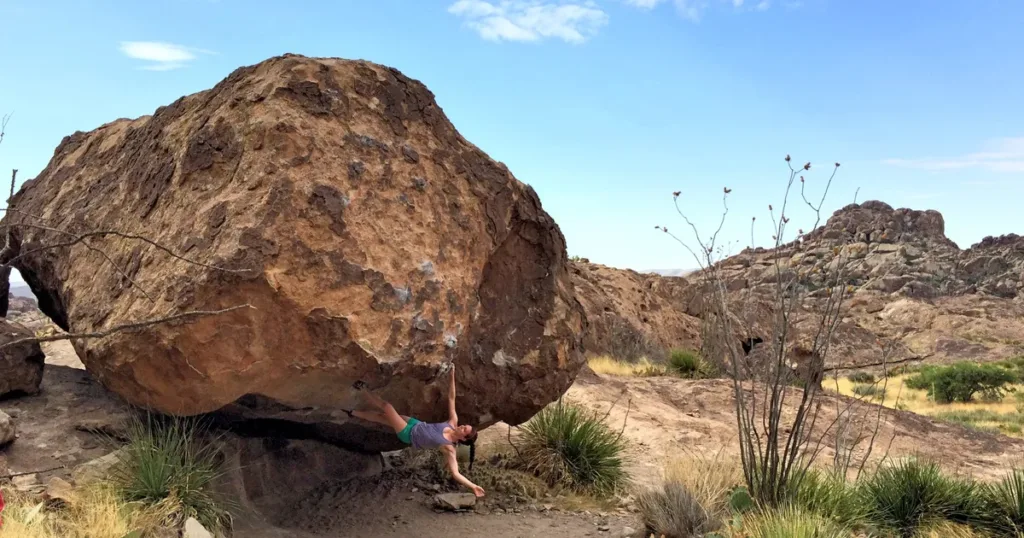
The scale today runs from V0 to V17. That apparent simplicity hides a wide margin of interpretation: an “easy” V8 and a “hard” V8 in the same American gym is the norm.
V17 stayed an open project for years, a sort of fantasised ceiling nobody had confirmed. The first confirmed V17 is Burden of Dreams, by Nalle Hukkataival. Daniel Woods then proposed V17 for Return of the Sleepwalker at Red Rock (Nevada) in 2021.
The V-scale dominates American gyms and the way English-speaking climbers talk about grades. When you watch a bouldering video on Mellow or open a guidebook for Hueco, Bishop or Red Rock, that is the scale you see. In France and continental Europe, Font is still the majority.
Font and V conversion table
Here is the conversion table most commonly used between Fontainebleau and the V-scale. Worth keeping in mind: these equivalences are indicative. The same problem can shift a notch from one scale to the other depending on the style.
| Fontainebleau | V-scale |
|---|---|
| 3A | V0 |
| 4A | V0 |
| 5A | V1 |
| 5B | V1 / V2 |
| 5C | V2 |
| 6A | V3 |
| 6A+ | V3 |
| 6B | V4 |
| 6B+ | V4 |
| 6C | V5 |
| 6C+ | V5 |
| 7A | V6 |
| 7A+ | V7 |
| 7B | V8 |
| 7B+ | V8 / V9 |
| 7C | V9 |
| 7C+ | V10 |
| 8A | V11 |
| 8A+ | V12 |
| 8B | V13 |
| 8B+ | V14 |
| 8C | V15 |
| 8C+ | V16 |
| 9A | V17 |
For the overview of every scale, routes as well as boulders, head to the climbing grades page.
Why the conversions are never perfect
The Font scale and the V scale do not measure exactly the same thing. That is the underlying reason a problem shifts a notch depending on which scale you apply to it.
Fontainebleau favours total effort and reading. A problem with 8, 10 or 15 moves means managing your effort and reading the sequences as you go. Font grading factors that management in: a long, sustained problem can easily get a high grade even without an extreme move in it.
The V-scale, heir to Hueco Tanks and American overhangs, gives more weight to pure power and to the maximal move. A violent dyno on 3 moves or an explosive crux pulls the V grade up faster than Font does.
The concrete consequence on the rock: a long, sustained compression on big holds is often rated higher in Font than in V. Conversely, a very powerful single-move problem, the short explosive overhang type, will be more generous in V than in Font. When you see 7A listed as V7 in some guidebooks and V6 in others, that is not a mistake, it is this bias at work.
Boulder vs route: why a 7A boulder is not a 7a route
Classic beginner mistake: thinking a 7A boulder is the same as a 7a route. The 2 scales share a visual notation (numbers and letters), but they are not calibrated on the same difficulty at all.
The most widely accepted rough conversion: a Font boulder roughly matches a route graded 3 to 4 notches higher. A 7A boulder is worth about a 7c route in terms of physical difficulty over a few moves. A 6A boulder sits around 6c+ route, an 8A boulder around 8b+ route. Ballpark, nothing more.
For how route grades are worked out and the detail of what is actually being measured, go and see the full overview on route climbing grades.
Grading in indoor climbing gyms
Indoors, grading is a subject of its own. The big French chains (Climb Up, Block’Out, Arkose, Vertical Art) add an extra layer on top of traditional grades: the hold colour code. Yellow, green, blue, red, black, purple, white… each gym has its own palette. A colour stands for an in-house level range (for example “blue = 6B/6C”) that does not match any universal grade. A blue at Arkose Nation is not worth a blue at Block’Out Lyon.
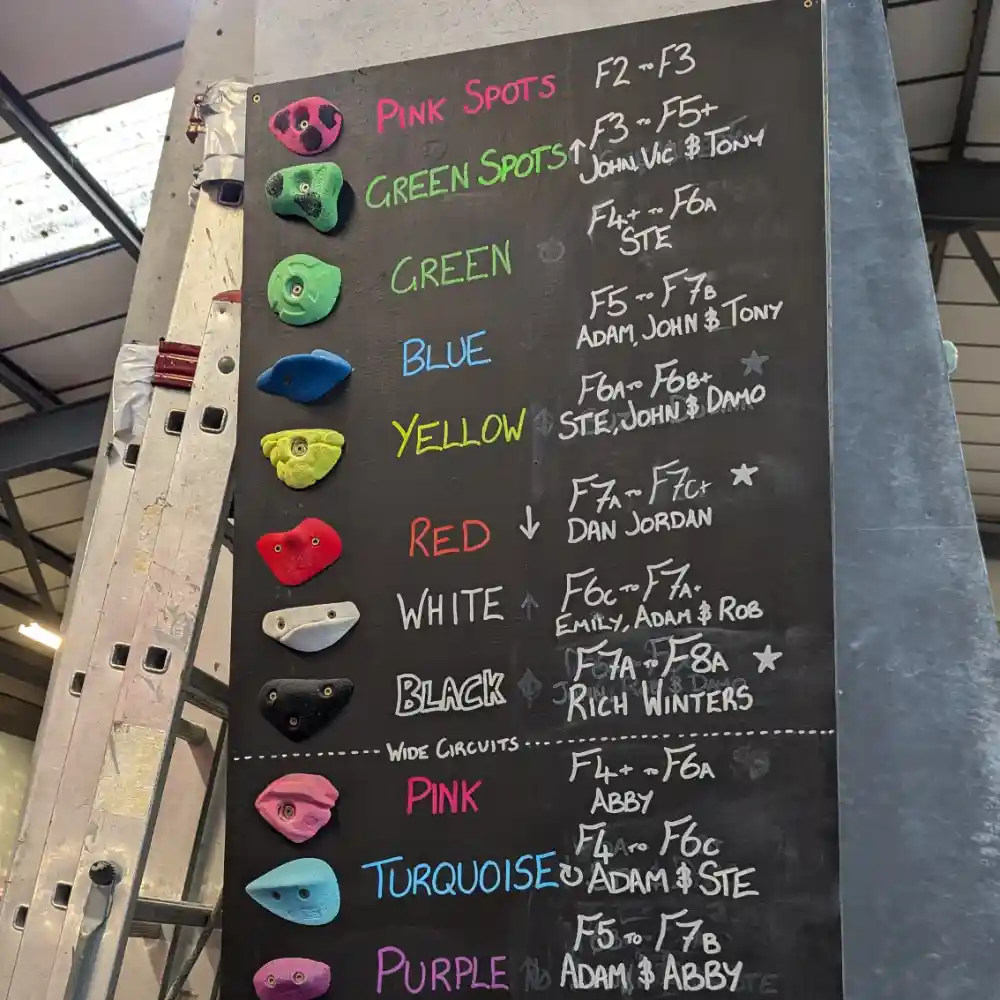
Another well documented bias: gyms have a commercial interest in grading generously so the customer feels good about themselves. A climber who cruises V5 on plastic can take a serious slap in a historical 6C at Bleau. It is not that they have gone backwards, it is just that the 2 worlds are not calibrated the same way. The subject is dug into in detail on gym vs crag grades.
Bouldering specifics that shift the grade
Not all problems are equal, even at the same grade. Each style has its own assessment bias, and knowing how to read them saves you a lot of frustration.

- Compression: you squeeze between your 2 hands and/or your 2 feet, often on an arete or a volume. Very global effort, difficulty tied to core tension. Often overgraded for climbers with a big wingspan, undergraded for smaller builds.
- Dynamic: strong explosive and coordination component.
- Slab: balance on small footholds. Grades historically hard to calibrate, very dependent on the quality of your shoes, on trusting the friction and on reading.
- Roof (cave climbing): roofs, caves, overhangs at 30° and beyond. Draws massively on strength and a core of steel.
- Traverse: long sideways movement, halfway between a boulder problem and a short route. Font grading handles sustained traverses well, the V-scale much less so.
Concrete landmarks grade by grade
To place your level and your goals:

- 4A to 5A: beginner level. The moves stay accessible, the reading is simple, the holds are big. If you are starting bouldering in a gym, this is where you spend your first weeks.
- 5B to 6B: the intermediate band, the most crowded one. A regular climber training 2 to 3 times a week can reach 6B in 1 to 2 years. This is the level where the typical techniques show up: heel hook, dyno, drop knee…
- 7A: expert threshold. The first real “step” where finger strength becomes decisive. A 7A at Bleau is a strong symbolic milestone.
- 7C: rare band. Beyond 7B+, the population of climbers involved shrinks massively. At this level, specific max strength work and structured hangboard training can start to become essential
- 8A: elite. The 8A boulder is still a very strong marker, comparable to an 8b+ route. A few thousand climbers on the planet have done it.
- 9A: world elite level. A handful of ascents since 2016. Slowly spreading among the very top boulderers.
If you are looking to break through a plateau, finger strength and structured hangboard training can become decisive. For the overall method and the levers of progress, go and see progressing in climbing. All the technical vocabulary of bouldering (compression, dyno, hooking, dihedral…) is listed on the climbing glossary.
FAQ
What is a V4?
A V4 matches a 6B boulder in Fontainebleau grading. It is an intermediate level. At this stage, you start linking moves that demand reading and active core tension, on footholds that keep shrinking.
What is the difference between V and Font?
The V-scale is the American scale invented by John Sherman at Hueco Tanks, linear (V0 to V17). Fontainebleau grading is the historical European scale born at Bleau, finer grained (letters and “+”), which takes more account of the length of the problem and of reading. The 2 scales cover the same levels but do not line up exactly.
What are the hardest boulder problems in the world?
9A (V17): Burden of Dreams, put up by Nalle Hukkataival at Lappnor (Finland) in 2016 // Alphane, freed by Shawn Raboutou at Chironico (Switzerland) in 2022 // Return of the Sleepwalker, put up by Daniel Woods at Red Rock in 2021
A propos de l’auteur
Woodrock c’est le mariage de 2 passions : la menuiserie et l’escalade. Concevoir, fabriquer, usiner et vous envoyer des poutres d’escalade de qualité est une partie de mon quotidien. Le reste du temps, j’aime grimper sur les falaises des contreforts du Vercors.